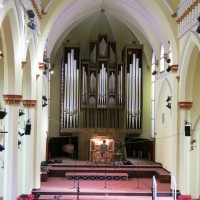
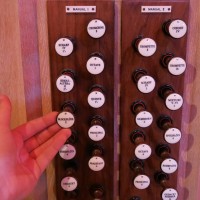
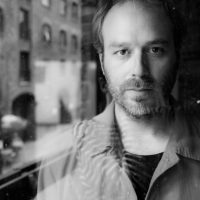
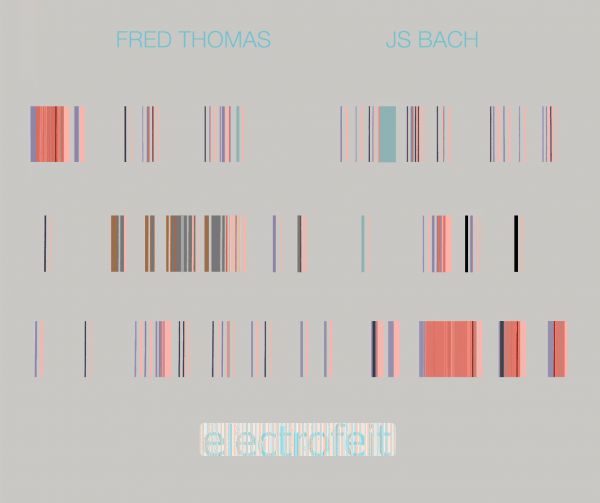
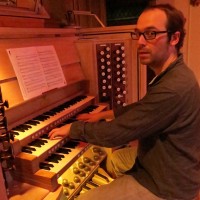
As part of his research into the music of J.S.Bach, Fred Thomas has delved into the world of the organ. Electrofeit is an album of J.S. Bach solo organ music released by music publisher and record label The Silent Howl. This was followed by ‘Cut From Air‘, released in 2023.

“In a word: sublime” SilenceAndSound

Some words on ‘Electrofeit’:

There were several sources of inspiration for this recording: a sudden love affair with church organs, Walter Benjamin’s “The Work of Art in the Age of Mechanical Reproduction” and Glenn Gould’s obsession with technology and how it relates to classical music. Then I heard some lectures by the historian Hayden White that seemed relevant to the interpretation of art from the past. His ideas are a gift to anybody interested in period performance practice.

Here are some of Hayden White’s thoughts (paraphrased):

 How can a creative student of the past use imagination to supplement the kind of knowledge, always fragmentary, always incomplete, often hidden, that historical methodologies dig up? Is there an essence that you can derive from a combination of so-called scientific enquiry and poetic imagination, without transforming fact into fiction? In fact, what is the status of fact and fiction? Can they even be clearly demarcated?

 History can be an artistic treatment of reality. Novelist Toni Morrison says her book ‘Beloved’ is “historically true in essence, but not strictly factual”.

Literary devices such as the anecdote or epigraph are instruments for treating the past artistically, for interpreting facts poetically, for drawing attention to your message by giving it formal coherence. Form articulates or even enacts message. These literary devices are poetic precisely in so far as they draw attention to their own processes of production. They tell you something about the text itself.

To tell things chronologically results in a chronicle. To relate a history you must violate chronology, and it’s this that gives it narrative force. Why do we want a narrative or story? Because identifying the structure that holds events together in a particular pattern of cause and effect or functional relationship is not enough; the dramatisation of events is key i.e. to separate agents into protagonists/antagonists, strong/weak, agents/patients and thus extract meaning.

All of this relates deeply to recording music of the past. 
In the case of ‘Electrofeit’, I recorded the fugues by over-dubbing (multi-tracking) the voices. Starting off by recording a whole fugue with all its voices, I then replaced each voice individually, finally removing the original template from underneath – a bit like drawing on tracing paper on top of an original.

This ‘device’ tells the listener how I feel about the text. It draws attention to itself, through technological tricks such as panning, distance, eq and timbre. It dramatises the music by separating the voices into their ever-changing roles of protagonist or antagonist, leader or follower. And the device itself enacts the polyphonic nature of the music.

All of this might be vaguely true…
Press:

https://www.vice.com/en/article/kbng9v/fred-thomas-is-bringing-bach-into-the-21st-century

These pieces take on a deep and magical dimension…each detail revealed in overwhelming relief thanks to quality sound recording and mixing, supported by an interpretative finesse that brings to mind the contemporary and subtle games of a Glenn Gould. More than yet another standard interpretation of the works of J.S. Bach, ‘Electrofeit’ is a brilliant renewal of his work’s modernism, a wonderful bridge between past and present, a moment of auditory peace and contemplation. In a word: sublimeSilenceAndSound

Fred Thomas…is utilizing modern recording and post-production technologies to create unique compositions and reinventions of traditional classical music. By utilizing this kind of creative experimentation and exploring the realm of multi-track recording, Thomas is challenging the status quo of the classical music genre…Electrofeit is…a creative product and work of art wholly his own. Just as Brian Eno considers himself a composer beholden to the studio and constantly evolving recording technologies, Thomas is now pioneering this methodology in the classical genre. Electrofeit has a sound that is both more full and resonant than typical Bach recordings, with a sonic depth that can only be paralleled in music and film genres outside of the traditional The Creators Project

Click here to read the whole article.
Johann Sebastian Bach sought not to invent the musical rules of the universe, but to uncover them. His work remains uniquely transcendent, wise and childlike. Here he appears in transfigured light, with both sacred and secular works recast for piano trio by the British-Argentine musical polymath Fred Thomas. On Three Or One, Thomas’s 2021 ECM New Series release featuring Aisha Orazbayeva and Lucy Railton, the focus fell on Bach’s chorale preludes — works conceived for his “mother tongue,” the organ. The Orgelbüchlein (Little Organ Book) stands simultaneously as a compositional treatise, pedagogical method, liturgical collection and theological testament. Brimming with rhetoric and characterisation, these are amongst the composer’s most radical creations. With unparalleled technical ingenuity and emotional force, Bach sets the upright simplicity of Lutheran hymns within labyrinthine structures of inexhaustible fantasy.

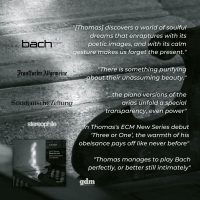
Three Or One was hailed as “mesmerizing” (BBC Music Magazine), praised for its “magnificent sonorities” (France Musique), and described as “immaculately conceived” (Mitteldeutscher Rundfunk). All Music remarked that it felt “very much like nothing anyone has heard before,” while Stereophile observed that “Thomas has shown himself to be both fearless and deferential in his interpretations.” Wolfgang Sandner of the Frankfurter Allgemeine Zeitung wrote: “There is something purifying about their simple beauty.”

For the trio’s second program, Thomas is joined by violinist Lena Neudauer and cellist Anja Lechner. Neudauer, whose repertoire stretches from Baroque to contemporary, plays with radiant tonal focus and a restless stylistic intelligence, lending both structural clarity and expressive freedom to the musical dialogue. Lechner, long associated with ECM and shaped by her collaborations across early, contemporary and improvised traditions, brings a rare inward gravity to the ensemble, her burnished sound both anchor and singing voice.

Together they explore the breadth of Bach’s stylistic universe, drawing on cantatas, dance suites, solo string works, the Goldberg Variations and The Well-Tempered Clavier. The results are transformative. These transcriptions gently unsettle conventional expectations of the piano trio, revealing instead the luminous clarity and inward joy inherent in the works. In the trio’s performances, the music remains wholly itself, yet freed from the provincial boundaries of time and place, leaving the sense that Bach fathoms and encircles everything.

Lena Neudauer – violin

Anja Lechner – cello

Fred Thomas – piano & musical direction

Three or One is an ECM New Series release.

Executive producer: Manfred Eicher

Transcriptions by Fred Thomas, published by Edition Wilhelm Hansen and available to buy here.

Video playlist of Fred Thomas discussing ‘Three or One’:

Mesmerizing…utterly beguiles…an illuminating if idiosyncratic BachianBBC Music Magazine

Lyrical and haunting….very much like nothing anyone has heard beforeAll Music

Let this programme sink in over several hearings and the music will quietly insinuate itself into your next playlistGramophone

One of the most transportive albums of the yearBetween Sound and Space

A Bach record to be rememberedRTBF Belgium

Fred Thomas is an astonishingly fine musician…highly effective, and deeply affectingThe Arts Desk

Magnificent sonorities and meticulous transcriptions from Fred ThomasFrance Musique

“Fred Thomas transfigures the master…interpreted with nuance and extreme sensitivityFIP Radio

There is something purifying about their simple beauty. With historical performance knowledge, musical sensitivity, while paying attention to the theological content, he carefully reorganized them with a multitude of different compositional techniques…subtly executed interpretations…stimulating transcriptionsWolfgang Sandner, Frankfurter Allgemeine Zeitung

Thomas’ ECM debut sees him elegantly arrange and reinvent a series of Bach sinfonias, vocal cantata and organ preludesThe Guardian

Immaculately conceivedMitteldeutscher Rundfunk

Wonderfully musical, sensitively communicativeFono Forum

Those led by their emotional response will be touched by Bach’s calm and grace. Church music becomes chamber musicStern

Magnificently performed…Thomas manages to play Bach perfectly, or better still intimately…lively, current, eclectic, contemporary…A precious recordingGiornale della Musica

Be prepared for something different from what you can possibly imagineYellow Box

This is a beautiful album that is flawless in its conception and execution and plunges the listener into Bach’s world with a fresh perspective and set of ears. Essential listeningJazzViews

Thomas has shown himself to be both fearless and deferential in his interpretations. He remains faithful to the source, radical in execution but beholden to the intention…an easy, joyful listenStereophile *****

Thomas’s solo flights are memorable…the three engage deeply with Bach’s material and execute it with the majesty, respect, and affection it deserves. The impression ultimately left is of musicians luxuriating in the splendour of the magnificent material they’re playing and savouring every moment of their real-time interactionsTextura